June 2026
Safety First
Everything we do in the water rests on one thing: The people beside you know exactly what to do if something goes wrong. Here is where that comes from, and a rescue drill in 360° HD.
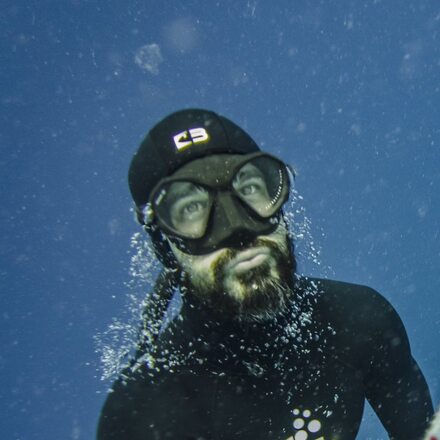

Would You Trust Your Life To A Stranger?
That is what you do every time you board a plane or taxi, or even when you cross a busy street. You don't know the pilot personally, or the cab driver, so what are you really trusting? A system. A set of standard protocols for safe and efficient operation... It's the same in freediving.
That is what you do every time you go underwater. You are on a single breath, and if something goes wrong, the person at the surface is the difference between a good story and a tragedy.
So when I built Costa Freediving I had one non-negotiable: Safety cannot be an afterthought. Not a page of legal jargon. It has to be baked into the DNA of the thing.
Which is why I am so grateful to have learned from Martin Stepanek and worked with him as a partner on many aquatic adventures.
Who Is Martin Stepanek?
Martin is a thirteen-time world record holder in freediving. He has been past 400 feet on a single breath. Pause on that for a second. An insane level of danger, handled, because he was methodical and adamant about safety.
And he did not drift off into the sunset. He founded Freediving Instructors International, the agency known for its science-based approach to safety and training, and worked with researchers from Harvard and the Karolinska Institute on the physiology of freediving. He has spent a career pushing the limits of what is humanly possible underwater, and making sure other people can do it safely.
Martin taught me how to stay safe on a single breath, and how to keep my students safe when I teach. Every dive I supervise, every buddy protocol, every rescue I drill comes straight from that lineage.
What A Rescue Looks Like
This is what the safety training in the Level 1 course looks like, filmed in 360° by Andrew James Ferris at Hospital Hole. I dive the line to 10 meters and call for help. Courtney, my student, comes down to meet me, secures my airway, brings me up, and runs the full surface protocol. Calm, practiced, by the book.
Hit Play! Then, click and drag (or swipe) the video to look around.
Every Level 1 student drills this. Shallow water blackout is a real risk. It is the reason freedivers always dive with a trained safety buddy, never alone, and the reason freediving done right is so safe.
Why This Matters For You
On every adventure, Martin either joins himself or his fingerprints are on the safety standards. A dedicated safety diver watches every dive. The protocols were not borrowed from a textbook. They come from someone who has been to the edge and back thousands of times, and kept his students safe for over 25 years.
Does that mean nothing can ever go wrong? No. But it means the safety framework around you is the gold standard in freediving, so you can focus on the water: The blue, the whale song, the manatee drifting beside you.
That is a different kind of trust.
More Stories

